In short
- Durban has had no standing rationing timetable in 2026. Each outage has come with its own notice, its own list of reservoirs and its own recovery time.
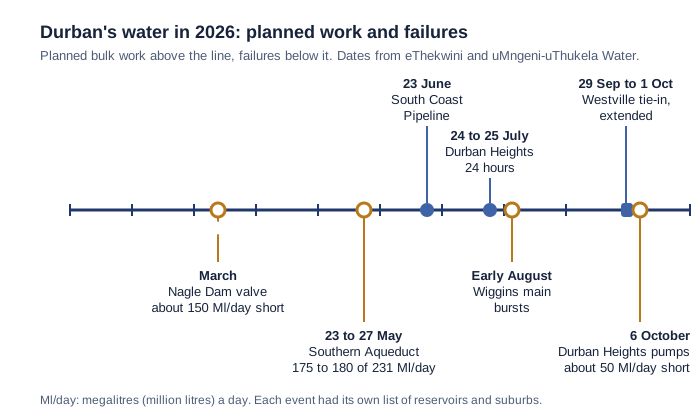
- The big ones so far: the Nagle Dam valve in March, Southern Aqueduct rationing in May, the 24-hour Durban Heights shutdown in July, the Wiggins main in August, the Westville tie-in from 29 September, and a pump failure in October.
- In 2025, 44% of eThekwini households reported water outages lasting two days or more, the highest share of the eight metros (Stats SA figures, via GroundUp).
- Report no water or a burst to eThekwini on WhatsApp 073 148 3477 or toll-free on 080 311 1111. When the water returns, open the lowest, furthest cold tap slowly.
A water outage in Durban has not followed a timetable in 2026. Instead of a published rationing schedule, the supply has gone off one event at a time, each with its own notice, its own list of reservoirs and its own recovery time. This guide sets out the record for the year so far, how to tell rationing from a burst, how to report it, and what Durban plumbers check in a house once the water is back.
Some background makes the record easier to read. The bulk supplier is uMngeni-uThukela Water. Its Durban Heights Water Treatment Works, which supplies a large part of the metro, takes raw water from Nagle Dam through the Nagle aqueducts and sends treated water out along the Northern and Southern Aqueducts to eThekwini's reservoirs. The Wiggins works and its high-pressure main feed other parts of the city. A fault anywhere on that chain shows up as dry taps in suburbs that can be a long way from the work.
Why Is There Suddenly No Water In Durban?
Three kinds of event have caused this year's outages, and each one looks different from the kitchen tap.
- Planned bulk work. uMngeni-uThukela Water or the City shuts part of the bulk system to repair or connect pipe, and eThekwini publishes a notice beforehand with the hours and the reservoirs affected. The 24-hour Durban Heights shutdown was announced on 23 July for the next morning, and the Westville tie-in on 23 September for the 29th.
- Bulk failures. A valve, a pump or a main fails without warning, and less water reaches the reservoirs than the city uses. The City then rations to protect what is in storage: during the Wiggins repairs it warned that water supply outlets may be temporarily shut, and in October it said the priority was "to prevent reservoirs from being depleted while the reduced bulk supply continues".
- Local bursts. A main in the street splits, crews isolate a section to repair it, and a few streets go dry.
Water Outages In Durban In 2026: The Dated Record
These are the bulk events of 2026 that eThekwini or uMngeni-uThukela Water announced, in date order. Each notice named more areas than the ones given here, so check the full list in the source if your suburb is not mentioned.
March: The Nagle Dam Valve
During routine maintenance at the Nagle Dam intake tower, Sleeve Valve No. 2 failed when its gearbox shaft snapped while it was being reopened, according to the reply to a parliamentary question to the Minister of Water and Sanitation. With only one valve working, less raw water reached Durban Heights. In a joint statement on 14 March, eThekwini and uMngeni-uThukela Water put the shortfall at about 150 megalitres a day.
The rationing plan that followed opened the Northern Aqueduct reservoir outlets twice a day for three hours, opened the Umlazi and Chatsworth reservoirs for three hours in the morning and three in the afternoon, and throttled the inlet at Northdene 3, which feeds the Shallcross, Chatsworth 4, St Wendolins, Washington Heights and Intake Road reservoirs, to 15%. Tankers filled at points that included the Mobeni and Jeffels Road depots, and the statement allowed two weeks for the reticulation system to recover fully once Durban Heights was treating at full capacity again. By 16 March the City said reservoirs were filling but the system had not yet fully recovered, with Phoenix, KwaMashu, Umhlanga, Durban North, Newlands and Mount Edgecombe on the Northern Aqueduct, and Chatsworth, Umlazi, Westville and Shallcross on the Southern, among the areas affected.
23 To 27 May: Southern Aqueduct Rationing
The Southern Aqueduct is being rebuilt, and its tie-ins carry their own risk. On 22 May contractors finished tying in and commissioning a new 1,600 mm steel pipeline, but one section of the old prestressed concrete pipe in Northbourne Road, Westville, which lies in the new line's path, had to stay closed. That left the aqueduct able to deliver 175 to 180 megalitres a day against the 231 it needs. eThekwini rationed from midday on 23 May until Wednesday 27 May while four lengths of the old pipe were replaced. The reservoirs named ran from Chatsworth 1 to 4, Shallcross, Klaarwater and Westcliff to Umlazi 1 to 6 and Folweni 1 and 2.
23 June: The South Coast Pipeline
eThekwini's public notice of 20 June warned that uMngeni-uThukela Water would isolate the South Coast Pipeline, fed from Amanzimtoti Waterworks Reservoir 4, from 08:00 on 23 June for repairs expected to be finished by 18:00. Reservoirs were filled the night before, and the City said full recovery could take up to two days after the shutdown. Winklespruit, Warner Beach and Illovo Beach were among the areas listed.
24 To 25 July: The 24-Hour Durban Heights Shutdown
The March failure led straight to July's planned outage. In a joint notice on 23 July, uMngeni-uThukela Water and eThekwini announced a 24-hour interruption, from 07:00 on Friday 24 July to 07:00 on Saturday 25 July, for everyone supplied from Durban Heights. The original sleeve valve had failed in March, and since its removal the Nagle aqueducts had been running on a stop block, which the notice called a significant operational risk. A complete shutdown was needed to install an isolation valve on Aqueduct 2 and to replace Sleeve Valve No. 2 at the Nagle Mushroom House.
The areas listed covered both aqueducts. On the Northern Aqueduct they included Phoenix, KwaMashu, Ntuzuma, Inanda, Newlands, Avoca, La Lucia, Umhlanga, Durban North, Springfield and Mount Edgecombe; on the Southern, Chatsworth, Shallcross, Umlazi, Folweni and Westville.
Early August: The Wiggins Main
In the first week of August, two bursts on the Wiggins main, along Vusi Mzimela Road and in Seaview, cut water to Woodlands, Bluff, Lamontville and Mobeni. By the Thursday the City was making emergency repairs to the 750 mm steel pipe of the high-pressure supply main from the Wiggins Treatment Works, and the South Ridge, Cato Manor and Ridge View reservoirs were interrupted while the network was isolated for the repair. The same report covered councillor Samier Singh's motion asking the City to look into an online dashboard of ward-by-ward water outages, planned maintenance and estimated repair times.
29 September To 1 October: The Westville Tie-In
The next Southern Aqueduct shutdown ran from 06:00 on Tuesday 29 September to 06:00 on Thursday 1 October, for the construction and tie-in of two major connection chambers under Work Package 6 in Westville. The reservoirs listed included Northdene, Chatsworth 1 to 4, Shallcross, Klaarwater and Westcliff in the Central Region, and Umlazi 1/1A to 6 and Folweni 1 and 2 in the South. On 1 October the City said technical challenges had delayed the work and extended the shutdown, with water expected back later that Thursday rather than at 06:00.
The work is part of the R1.2 billion Southern Aqueduct project. On 29 September Infrastructure News reported the commissioning of a section of Work Package 2, part of a 3.8 km pipeline between Shallcross and Northdene, which it said serves about 300,000 residents in central and southern Chatsworth and about 500,000 further downstream in uMlazi and Folweni.
6 October: The Durban Heights Pumps
Days later, a technical failure at pumps run by uMngeni-uThukela Water, which supply the Durban Heights works, cut the City's bulk supply by about 50 million litres a day. Areas on the Northern Aqueduct and the Mount Moriah Reservoir were hit, including Phoenix, Newlands, KwaMashu, Ntuzuma, Umhlanga and Durban North, and repairs were expected to be finished by that Thursday.
This is a record, not a schedule
The dates above are past events, taken from the notices of the time. For what is planned this week, go by eThekwini's current notices for your area.
How Common Are Long Water Outages In Durban?
More common than in any other metro. Stats SA's General Household Survey for 2025 asked households about water interruptions, and GroundUp's report on the results found that 44% of eThekwini households had outages lasting two days or more, the largest share of the eight metros. Nationally the figure was about 38%, and across the metros it was 30%.
The practical reading for a household is to plan for two days without water, not two hours: know where your stopcock is, keep drinking water stored, and know whether the geyser and any tank and pump on the property are set up for a supply that stops and starts.
How To Tell Rationing From A Burst
- There is a notice. Planned work and bulk failures both end up in eThekwini notices that name reservoirs and suburbs. If your area is on one, the problem is upstream and the notice will say roughly when to expect water.
- The water comes and goes. Under rationing, reservoir outlets open and close at set times, as they did in March, so the supply returns for a few hours and stops again, often weak at the start and the end.
- Water in the road. Water running along the gutter or bubbling through the verge, with the neighbours on either side also dry, points to a burst main in the street.
- Only your house. If the neighbours have water and you do not, close every tap and look at the meter. If it is still turning, water is escaping on your side of it.
How Can I Check For Water Outages In My Area?
eThekwini publishes its interruptions as press statements on durban.gov.za and on its Facebook page, usually with a list of reservoirs and the suburbs each one serves, and its notices point residents to the eThekwini Municipality mobile app for water queries. Look for your reservoir as well as your suburb. The notices group areas by the reservoir that feeds them, and work in one suburb can dry out reservoirs a long way off, as the Westville tie-in did for Chatsworth and Umlazi.
How Do I Report No Water In My Area?
eThekwini's own notices give four channels for water queries and faults:
- WhatsApp: 073 148 3477
- Toll-free: 080 311 1111
- Email: eservices@durban.gov.za
- The eThekwini Municipality mobile app
Give the suburb, the street and the nearest cross street, say whether water is running in the road, and keep the reference number. Report a burst you can see even when your own taps still work. A plumber cannot restore a street supply; the City has to.
What To Do When The Water Comes Back On In Durban
The first water through a drained pipe pushes air ahead of it, and that air is what makes taps spit and pipes bang. While the supply is off, keep the taps closed and switch an electric geyser off at the distribution board, as Santam advises for the whole of an outage. When the water returns, open the lowest, furthest cold tap slowly and let it run until it flows steadily, then open the others one at a time, hot taps included, before the geyser goes back on. Our guide to water hammer in Durban explains why that order matters.
Then give the network time. After the uMhlanga and Durban North interruption in April 2025 the City said affected reservoirs would need at least two days to return to normal levels, and the South Coast Pipeline notice in June allowed up to two days for full recovery. Weak pressure on the first day or two is usually the system refilling.
These are not the system refilling:
- pressure that stays weak at your taps once the neighbours' is back to normal;
- pipes that bang every time a tap closes, days after the supply returned;
- a geyser overflow that keeps dripping after an outage;
- a meter that turns with every tap shut.
Those are faults on the property, and they are where water pressure repairs in Durban start: a pressure reading separates a supply pattern from a fault. If the water is back but the house is not right, send your suburb and what you are seeing through the form below, and we will come back to you.
Water Outage Questions From Durban Homes
Is there a water rationing schedule for Durban?
Not a standing one in 2026. This year eThekwini has rationed event by event, and each notice sets its own hours for the reservoirs involved. The last fixed timetable we found was from February 2025: 10am to 3pm and 8pm to 4am in the south and south-west, and 8pm to 5am in parts of Westville. Treat those as past windows, and check the City's notices for your area.
How long does water take to come back after a shutdown in Durban?
Longer than the shutdown itself, because the reservoirs have to refill. After the uMhlanga and Durban North interruption in April 2025 the City said affected reservoirs would need at least two days to return to normal levels. The South Coast Pipeline notice in June 2026 allowed up to two days for full recovery, and after the Nagle Dam valve failure in March 2026 the joint statement allowed two weeks for the reticulation system to recover fully.
Why did my suburb lose water when the work was somewhere else?
Because one bulk main feeds many reservoirs. The tie-in work in Westville at the end of September cut reservoirs serving Chatsworth, Shallcross, Umlazi and Folweni, and the July Durban Heights shutdown covered areas from Phoenix and Umhlanga in the north to Umlazi in the south. The notices list areas by the reservoir that feeds them, so look for your reservoir as well as your suburb.
Who do I contact when there is no water in Durban?
eThekwini Municipality. Its notices give WhatsApp 073 148 3477, the toll-free number 080 311 1111, the email address eservices@durban.gov.za and the eThekwini Municipality mobile app. A plumber cannot restore a street supply, but can deal with anything on your side that leaks or misbehaves once the water is back.
Should I switch off my geyser during a water outage?
Yes, if it is electric. Santam advises switching the geyser off for the whole of an outage, because a geyser that runs empty can dry-heat and damage the element and thermostat. Switch it back on once the hot taps run steadily again.
Sources
- Parliamentary Monitoring Group: Question NW1548 to the Minister of Water and Sanitation, and reply (Sleeve Valve No. 2 at the Nagle Dam intake tower) (question dated 13 April 2026)
- uMngeni-uThukela Water and eThekwini Municipality: Joint statement on the water situation in eThekwini Municipality (about 150 megalitres a day short, the rationing plan, tanker points) (14 March 2026)
- The Mercury (IOL): eThekwini water update: Reservoirs filling up, system recovery underway (areas on each aqueduct) (16 March 2026)
- eThekwini Municipality: Emergency water rationing implemented for areas supplied by the Southern Aqueduct (23 May 2026)
- eThekwini Municipality on Facebook: Public notice, interruption of bulk water supply on the South Coast Pipeline (20 June 2026)
- South Coast Sun (Citizen): These South Coast areas will be affected by a water shutdown (22 June 2026)
- eThekwini Municipality: Joint media and public notice between uMngeni-uThukela Water and eThekwini Municipality (24-hour Durban Heights shutdown) (23 July 2026)
- The Post (IOL): eThekwini councillor calls for water outage alerts amid ongoing supply challenges (the Wiggins main) (6 August 2026)
- eThekwini Municipality: Planned water supply interruption on the Southern Aqueduct pipeline (23 September 2026)
- Infrastructure News: eThekwini commissions key section of Southern Aqueduct (29 September 2026)
- East Coast Radio: eThekwini water shutdown extended (1 October 2026)
- GroundUp: The metros where long water interruptions are most common (Stats SA General Household Survey 2025) (2 October 2026)
- East Coast Radio: eThekwini reduced water supply (Durban Heights pumps) (6 October 2026)
- eThekwini Municipality: Improvement of water supply in uMhlanga and Durban North (9 April 2025)
- TimesLIVE: eThekwini implements water rationing schedule to meet demand (21 February 2025)
- Santam: Getting ahead of the next water outage: tips to protect your geyser (10 August 2023)
Written by The Durban Plumbers, plumbers in Durban working across eThekwini, from Umhlanga and Durban North to Westville, Chatsworth and Amanzimtoti. This is general guidance; a plumber on site can tell you what applies to your property.