In short
- Water hammer is the bang you hear when moving water stops suddenly, for example when a tap is shut fast or a washing machine valve snaps closed.
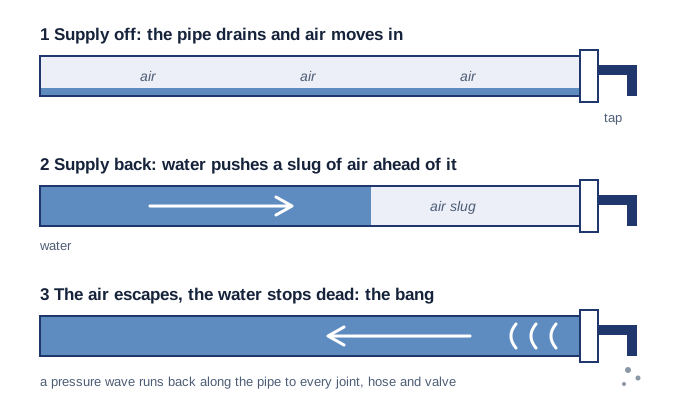
- In Durban the refill after rationing is a second, often harder hammer: a drained pipe fills with air, and when the air escapes at a tap the water behind it stops dead.
- When supply comes back, open the lowest, furthest cold tap slowly and let it run steadily, so the air leaves through a tap and not through the geyser.
- Banging every time a tap closes, with full supply, is not refill noise. It points to high pressure, a failed pressure-control valve or loose pipe clips.
Water hammer is the plumbing name for banging pipes: the thud in the wall when a tap is shut, or the knock from the kitchen when the washing machine stops filling. Most cities only get the first kind. Durban gets a second, because its supply stops and starts. This guide explains both, what they do to a house, and when the banging needs a plumber in Durban.
eThekwini has rationed water in parts of the city more than once in the past two years: after uMngeni-uThukela Water cut its bulk supply to the city in October 2024, and again in March 2026, when a valve seized shut at Nagle Dam and restricted the raw water reaching the Durban Heights works. Each time a zone drains and refills, air travels through the pipes ahead of the water, and that air is what turns an irritating knock into wear on joints, hoses and geyser valves.
What Water Hammer Is: Why Pipes Bang When A Tap Closes
Water moving through a pipe has weight and speed. Close a valve slowly and the water slows with it. Close it in a fraction of a second and the moving column piles up against the valve, the pressure there jumps well above normal, and a pressure wave runs back along the pipe, bouncing off bends and tees until it dies away. The bang is that wave shaking the pipe against whatever it is fixed to.
Inside a house the usual triggers are appliance valves and fast taps. Washing machines and dishwashers fill through an electric solenoid valve that shuts instantly, which is why a sharp knock as a machine moves between fill stages is the classic sign. Lever mixers and quarter-turn valves can also be slammed shut far faster than an old screw-down tap.
Why Water Hammer Is Worse In Durban: Air On The Refill
When a zone is shut off, the pipes downstream do not stay full. Water drains to the low points and air comes in to replace it, through air valves on the City's mains and, at your house, partly through the geyser's vacuum breakers.
When supply returns, the water pushes that air ahead of it as a slug. Air slips easily through a part-open tap; water does not. So when the last of the air squeezes out, the column behind it has to slow almost instantly: the same sudden stop as a fast-closing valve, often at speed, because an empty pipe gives the water nothing to push against. Air caught at high points compresses and springs back until it clears, which is the coughing tap and the run of thumps after an outage.
The City has met this at bulk scale. Reservoir 3 at Durban Heights was recommissioned late in 2023 after a refurbishment of about three years. eThekwini's acting deputy head of operations, Jabulani Mayise, said many of the 72 air valves along the 32km pipeline system from Durban Heights to Phoenix were damaged, apparently linked to the large volumes of air entering the pipelines during recommissioning. The City ordered 60 new air valves, which arrived on 26 January 2024. Phoenix residents said they had been without reliable water for more than 100 days.
In April 2025, after a supply interruption in uMhlanga and Durban North, eThekwini's fix included replacing air valves and scouring a 27km pipeline to release air that may have caused blockages.
Those are engineered valves on bulk mains, built to handle air. Behind your meter the same air meets 15mm pipe, compression fittings, braided hoses and a geyser in the roof.
The Rationing Schedule Behind The Banging Pipes
How often a house refills depends on its zone and the reservoirs. Two published examples:
- February 2025. After uMngeni-uThukela Water curtailed its supply to the city by 8.4%, eThekwini rationed in off-peak hours: 10am to 3pm and 8pm to 4am in the south and south-west, and 8pm to 5am in some parts of Westville. The municipal spokesperson, Gugu Sisilana, said: "Rationing is done to build storage. Water is reopened when there are sufficient levels."
- March 2026. After the Nagle Dam valve seized, the joint plan from eThekwini and uMngeni-uThukela Water opened every Northern Aqueduct reservoir outlet twice a day for three hours, a system serving areas including Phoenix, Umhlanga and Durban North. Chatsworth's outlets opened for three hours in the morning and three in the afternoon, and pumps to the Pinetown reservoirs ran 16 hours a day.
A zone whose reservoir opens twice a day can drain and refill twice a day, and each refill sends air through the house.
These are past schedules, not today's
The windows above are the ones published at those dates. Plans change with reservoir levels and repairs, so check eThekwini's notices for your area.
What Water Hammer Does To A House
One bang does nothing you can see. The damage is cumulative, and the weakest fitting gives first.
- Joints. Compression fittings creep loose and soldered joints crack where the pipe flexes most, usually at a bend near a fast valve. A joint inside a wall can weep for weeks before anyone notices, which is when leak detection becomes cheaper than guessing.
- Flexi hoses. The braided connectors under basins, sinks and toilets are crimped at each end. Repeated spikes work at those crimps, and a hose that fails tends to do it without warning, at mains pressure.
- Geyser valves. A spike can make the temperature and pressure relief valve weep, and grit carried in on a refill can lodge under its seat. Why a geyser often starts leaking days after an outage is covered on our geyser repair page.
- The pressure-control valve. A high-pressure geyser is fed through a pressure-control valve, often called the PRV, which holds the pressure down to what the geyser is rated for. It wears like any valve. If it fails open, full street pressure gets through, and the higher the pressure, the harder every hammer blow lands.
Stopping Water Hammer On The Refill: Open The Right Tap
The air in your pipes after an outage will leave somehow; what you can choose is where. Left alone, it escapes through whatever is open or weakest, and in many houses that is the geyser in the roof. Give it a better exit:
- While the supply is off, keep the taps closed. If your geyser is electric, switch it off at the distribution board until the taps run normally again.
- When the supply returns, go to the cold tap that is lowest and furthest from where the water enters the property, often a garden tap at the far end of the plot. A far tap gives the water a path through the whole run of pipe, so air and grit are pushed out instead of being trapped in a branch.
- Open it slowly, a little at first, so that when the last of the air clears there is less speed to stop. Expect it to spit and run milky. Milky water is fine air bubbles, and a glass of it clears from the bottom up within a minute.
- Once it runs steadily, open the other taps one at a time, slowly, hot taps included, so the air left in the geyser's pipework leaves through a tap.
This is a habit, not a repair. It costs nothing and takes a few minutes, so it is worth doing every time the supply returns.
Weak water for hours after it comes back
That is usually the network refilling: after the April 2025 repairs the City said affected reservoirs would need at least two days to recover. Our water pressure page explains how to tell a supply pattern from a fault.
When Banging Pipes Mean A Fault, Not The Refill
Some noise in the first minutes of a refill is normal on a rationed zone. These signs point to something on the property:
- A bang every time a tap closes, on an ordinary day. If supply has been on for hours and the pipes still knock whenever a tap shuts or the washing machine fills, the air is long gone. What is left is pressure that is too high, a failed pressure-control valve, or a pipe that is free to move.
- Banging that started recently. A house that used to be quiet has changed, and a failed PRV or a loose clip is more likely than the pipework itself.
- Banging with a dripping geyser overflow. Together they point at more pressure reaching the geyser than it should see.
- Rattling after the tap is closed, or a pipe you can see jump. Loose or missing clips let a pipe slap against brick or timber each time the wave passes, and it wears where it hits.
None of these is an emergency, but each is a reason to have the pressure measured.
What A Plumber Does About Water Hammer
The work starts with finding which cause is behind the noise.
- A pressure test. A gauge shows the incoming pressure, and a reading on the hot side shows whether the pressure-control valve is doing its job. Readings at different times of day separate a pressure problem from the rationing pattern.
- PRV checks. A valve that lets through too much, or creeps up when no water is being used, is replaced or set correctly for the geyser and fittings it protects.
- Arrestors where the shock starts. A water hammer arrestor is a small sealed chamber with a cushion of air or a sprung piston, fitted close to a fast-closing valve such as a washing machine connection, that soaks up the spike before it travels. It does nothing for air on a refill.
- Securing pipe runs. Loose or missing clips are replaced, and pipes resting on timber or brick are packed or re-routed.
If the pressure is fine and the noise only happens on a refill, the right answer is the tap habit above, not an arrestor.
If the banging is new, happens every time a tap closes, or comes with a dripping geyser overflow, book a pressure test or have the geyser checked using the form below. Tell us your suburb and whether the noise comes after a refill or every time a tap shuts, because that detail usually points to the cause.
Water Hammer Questions From Durban Homes
What does air in the pipes sound like?
Air on a refill makes taps spit, cough and hiss, with a run of uneven thumps that fade within a few minutes of running a tap. Water hammer from a fast valve is one sharp bang, the same each time, at the moment a tap or appliance valve shuts. On a rationed zone you can hear both on the same day.
Why have my pipes suddenly started banging?
First rule out the obvious: if supply has just come back, the noise is air and settles once the taps have been run. If it carries on with full supply, the likely changes are a pressure-control valve that has failed and is letting more pressure through, a pipe clip that has worked loose, or a new appliance or lever tap that shuts faster than the old one. A pressure reading separates them.
Is water hammer dangerous? Can it burst a pipe?
A single bang will not burst a sound pipe. The risk is repetition: a spike well above normal pressure, many times a day, finds the weakest joint, hose crimp or valve seat in the house. A flexi hose that lets go can flood a room quickly. Regular banging is worth having checked, but it is not an emergency.
Why do my pipes bang at night or early in the morning?
Pressure in a street main generally rises at night when demand drops, so fittings that cope by day can hammer after dark. On rationed zones the supply may also come back overnight: the windows eThekwini published in February 2025 ended at 4am in the south and south-west and 5am in parts of Westville. If it happens on nights with no outage, have the pressure measured.
Will a water hammer arrestor stop the banging?
Only if the cause is a fast-closing valve near where it is fitted, such as a washing machine connection. An arrestor will not stop air slamming through the pipes on a refill, bring down pressure that is too high, or hold a loose pipe still.
Sources
- Daily Maverick: 'We want water in our taps' - Durban residents vent their ire at top eThekwini officials (Reservoir 3, the 72 air valves on the Durban Heights to Phoenix pipeline, 60 replacement valves) (January 2024)
- eThekwini Municipality: Improvement of water supply in uMhlanga and Durban North (9 April 2025)
- eThekwini Municipality: City implements water rationing to manage water demand (21 February 2025)
- TimesLIVE: eThekwini implements water rationing schedule to meet demand (21 February 2025)
- uMngeni-uThukela Water and eThekwini Municipality: Joint statement on the water situation in eThekwini Municipality (Nagle Dam valve and the rationing plan) (14 March 2026)
- The Mercury (IOL): Durban water update: Rationing plan announced to stabilise supply (14 March 2026)
- The Mercury (IOL): eThekwini water update: Reservoirs filling up, system recovery underway (areas on each aqueduct) (16 March 2026)
Written by The Durban Plumbers, plumbers in Durban working across eThekwini, from Umhlanga and Durban North to Westville, Pinetown, Chatsworth and Amanzimtoti. This is general guidance; a plumber on site can tell you what applies to your property.